„When we build on our strengths, our weaknesses become irrelevant."
„The greatest opportunity to make a difference is to pay attention to what is already moving."
„When we focus on the positive, our mood and well-being improve."
„Having strengths doesn't mean you're good at everything. It means you have specific talents you can use to achieve excellence."
„There are no perfect people, only people with perfect talents."
„Strengths are the unique combination of abilities that make a person unique."
„Every person has strengths. When we recognize and nurture these strengths, we can motivate ourselves to extraordinary performance."
„We should focus not only on what we don't have, but also on what we do have."
„The real challenge is finding talents that others overlook."
„Success comes from focusing on what you can do, not from fixating on what you can't."
„When we focus on what we can do, we will be among the best in our field."
„It is the task of leaders to recognize and nurture the strengths of their employees."
„Strengths are the keys to peak performance."
„Every person has a unique combination of talents and abilities they can use to make their contribution to the world."
„Focusing on strengths creates an environment where people can unleash their potential and give their best."
„It's important that everyone knows and uses their strengths to get the best out of themselves."
„We must focus on our strengths to compensate for our weaknesses."
„When we focus on what we don't have, we waste our energy."
„Developing strengths is like lighting a fire – it takes time and effort, but once it's burning, it can't be stopped."
„When we use our strengths to help others, we can change the world."
„The greatest power we have is the power of choice."
„You were put on this earth to achieve your greatest self, to live your purpose, and to do it courageously."
„Where your creative attention flows, your life flows too."
„Inner confidence is the key to everything – the foundation on which a fulfilled life is built."
„Positive psychology calls on us to do what traditional psychology has never done – to deal with the good life and not just the bad life."
„The key to psychological health and happiness is to focus on your strengths, not your weaknesses."
„Happiness is not a goal, but a by-product of right action, of seeking meaning and satisfaction in our lives."
„Positive emotions are the fuel that drives us, and positive relationships are the goal we strive for."
„Positive psychology focuses on the study of what makes life worth living."
„The goal of positive psychology is to help people lead a fulfilled life by using their strengths and talents."
„Life is not a race. We should focus on developing our own strengths and fulfilling our own potential."
„Optimism is fuel for well-being and resilience. When we focus on the positive, we can better deal with challenges."
„Well-being is not just a state, but a process. It requires continuous attention and work."
„Resilience is the ability to recover from challenges and emerge stronger from them."
„The best way to predict the future is to create it."
„Effective management means doing the right things. Leadership means doing the right things."
„The most important thing in the communication process is to hear what is not being said."
„The greatest danger in times of change is not the change itself, but inadequate adaptation."
„One of the most important tasks of a manager is to recognize and nurture the strengths of their employees."
„Innovation distinguishes between a leader and a follower."
„Today's leaders must be aware that they are responsible for training tomorrow's leaders."
„One of the greatest challenges for managers is asking the right questions."
„Flow is a state in which we are completely absorbed in an activity that challenges us and brings us joy at the same time."
„Happiness does not come from material wealth, but from the way we shape our lives."
„Creativity emerges from the state of flow, when we fully concentrate on a task."
„The secret to a fulfilled life is finding an activity that challenges us and brings us joy at the same time."
„Life is a sequence of moments. The secret of happiness is to live each moment consciously."
„The ability to control and regulate our emotions is the key to a fulfilled life."
„The best experience in life is the one that means the most to you and that you pursue with the best intentions and greatest effort."
„The key to happiness is not the possession of things, but the ability to shape our environment and our life in a way that aligns with our needs and values."
„In a world full of distractions and interruptions, it is essential to consciously direct our attention and focus on the things that truly matter to us."
„Life is not only a search for happiness, but also a search for meaning and purpose. When we focus on what is essential, we can lead a fulfilled and meaningful life."
„Positive psychology is concerned with what is good in us and how we can strengthen these qualities to help ourselves and others."
„Positive psychology is not a science of happiness, but a science of well-being."
„It is more important to lead a meaningful life than a happy life."
„Positive psychology deals with the factors that contribute to people living a fulfilled and satisfied life."
„It is not about always being happy, but about leading a life full of meaning and purpose."
„We should not only focus on our weaknesses, but also cultivate and use our strengths and talents."
„Success and achievement are important, but they should not be attained at the expense of our well-being and health."
„Resilience and the ability to recover from setbacks are important factors for our well-being and life satisfaction."
„It is important to build and maintain positive relationships with other people in order to lead a fulfilled life."
„True well-being does not come from external conditions or circumstances, but from our inner attitude and stance toward life."
„Positive psychology is not a guide to happiness, but an invitation to lead a fulfilled life."
„Optimism is not a naive trust in the future, but a conviction that we have the ability to take our lives into our own hands and shape them."
„Strengthening character and virtues such as kindness, wisdom, courage, and justice can help us lead a more fulfilled and happier life."
„Being happy doesn't mean everything is perfect. It means you choose to look beyond the imperfections."
„True happiness comes from within. It has nothing to do with material things or external circumstances."
„A positive attitude is the key to happiness. Be grateful for what you have."
„People who help others and commit to something greater are often happier and more satisfied."
„The ability to control yourself and build positive relationships are important factors for a happy life."
„True happiness doesn't come from possessing things, but from the joy of living and the love for others."
1 / 71
Short and direct
Quick answers about the free resources
The key questions about this page, each answered in two or three sentences. Detailed case studies, resilience strategies and the glossary follow further down.
At a glance
What you get
Free PDF guides, e-books and exercises on strengths, purpose and resilience
Price
CHF 0 – no payment details, no subscription
Access
Enter your email address, the download link appears right away
Languages
German, English, French, Spanish (depending on the title)
Provider
PurposeCoach®, Philipp Fuchs – Gallup-certified CliftonStrengths® Coach, Bern/Wabern
Next step
Book a free 30-minute consultation to interpret your results
What do I get for free on this page?
You get the working material PurposeCoach® uses in real coaching sessions: the 34 CliftonStrengths® talent themes, the Purpose & Leadership Compass, a resilience set with self-test, work techniques, the Enneagram e-book, positive psychology and SMART goals. Every file is a PDF you can use immediately.
Are the downloads really free?
Yes. There is no cost, no credit card and no subscription. We only ask for your email address to deliver the download link and, if you want, to tell you about new resources. You can unsubscribe at any time.
Who are these resources for?
For people aged roughly 30 to 55 facing a professional decision: career change, a first leadership role, constant pressure or the feeling of not using their talents. Leaders use the same material for team conversations about strengths, values and resilience.
What is the difference between a talent and a strength?
A talent is a naturally recurring pattern of thinking, feeling and behaving. A strength only emerges when that pattern is practised consciously, dosed and applied in the right context. This translation – recognise, understand, apply – is the core of every resource here.
Do I need coaching to use the PDFs?
No. Each file works on its own and contains reflection questions and concrete exercises. A conversation helps when you want to apply your results to a specific decision, such as a job change, a leadership situation or ongoing exhaustion.
How to use a resource in four steps
The same sequence we use in sessions. It takes about 45 minutes and keeps the PDF from sitting unused in your downloads folder.
1
Choose one resource: Pick a single topic: strengths, purpose or resilience. Do not start several PDFs at once.
2
Do the exercise in writing: Answer the questions once by hand – notes kept only in your head lose their effect within two days.
3
Name one pattern: Turn your answers into one recurring observation: where does your strength create energy, where do you overuse it?
4
Define one step: Commit to one action for the next seven days that is small enough to survive a stressful week.
Freebies
Consultation
Free Consultation
Get to know us without obligation and learn how we can support you on your journey – completely free.
All Purpose resources from PurposeCoach® at a glance: the Purpose & Leadership Compass e-book plus further reading – download the PDF directly, no email required. (Document in German.)
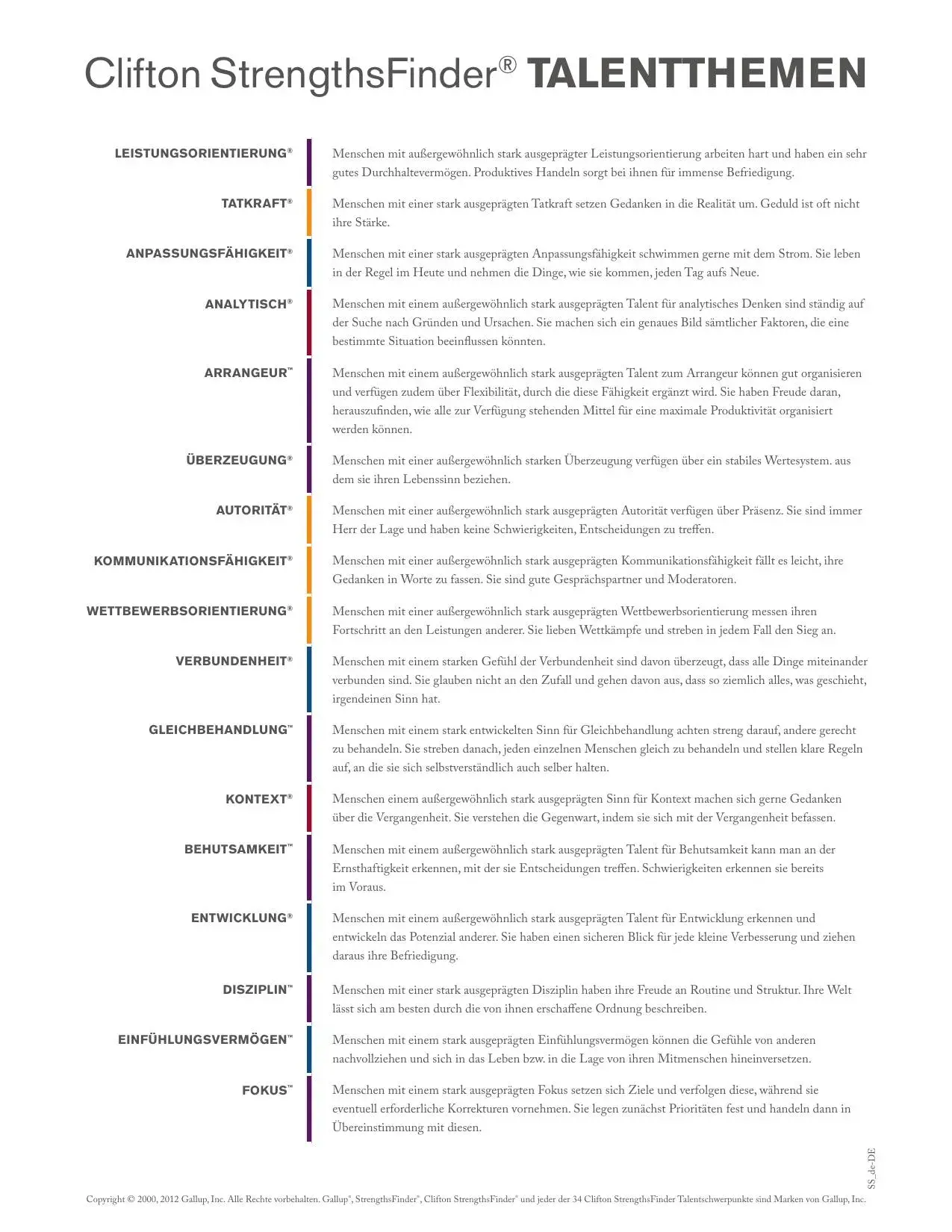
Comprehensive guide to CliftonStrengths® & the 34 talent themes: recognise, develop and apply your strengths in everyday life – download the PDF directly, no email required. (Document in German.)
Understand happiness, meaning and well-being scientifically: a compact e-book on the core concepts of Positive Psychology by Seligman, Csikszentmihalyi & Diener – with practical impulses for everyday life. (Document in German.)
E-Book
Setting SMART Goals
How to set goals that actually work: a step-by-step guide to the SMART method with templates, coaching & leadership examples and reflection questions for everyday life. (Document in German.)
Free PDF, instant download
Your strength profile in 20 minutes – the exercise as a PDF
Enter your email and get the compact strength-profile exercise as a PDF: five steps to put your energy sources, your strength pattern and your next step in writing.
5 steps, completed in 20 minutes
Energy review, strength pattern and energy drains
Your strength-profile sentence plus a concrete next step
Subscribe to the Purpose newsletter
Get new articles, insights and dates straight to your inbox – short, practical, unsubscribe anytime.
Free · PDF · no sign-up
The Potential Compass
The workbook for the audiobook “Your Potential Compass”: five reflection exercises and a 7-day transfer plan that turn your strengths, values and next steps into clear decisions.
What you get
Clarity about your top strengths and where they stay unused today
A written target picture instead of vague intentions
Concrete micro-steps for the next seven days
A solid basis for your free 30-minute consultation
What's inside
A4 · printable · approx. 20 minutes per exercise
1. Where you stand
An honest, measurable snapshot of your professional and personal situation.
2. Strengths inventory
Recognise and name your recurring talent patterns.
3. Values compass
The five values that actually drive your decisions.
4. 12-month target picture
A concrete, verifiable picture of your next stage.
5. Obstacles & resources
What slows you down – and who or what carries you.
7-day transfer plan
Daily micro-steps so insights reach your everyday work.
Frequently asked questions about the Potential Compass
The four questions we hear most often in first conversations – answered clearly.
What does the Potential Compass cost?
The workbook is free and available as a PDF without an email sign-up. Only the audiobook (CHF 17.00) and the audiobook + e-book bundle (CHF 27.90) are paid. Coaching follows the price list on this site; the first 30-minute consultation is always free.
How much time do I need?
Plan roughly 20 minutes per reflection exercise, so about 100 minutes for all five. The 7-day transfer plan is designed for 10 to 15 minutes a day. You can work through the exercises one at a time – one block per week works as well as a single weekend.
How scientifically grounded is the approach?
The exercises build on well-researched methods: strengths-based interventions, written goal clarification and self-distancing. The cited studies are linked with their DOI in the evidence section of the transfer page, including their limitations. The compass replaces neither diagnostics nor therapy – it is a reflection and decision-making tool.
Who is the Potential Compass for?
For professionals and leaders between 30 and 50 who face a career crossroads or want to use their strengths more deliberately. It is not suitable during acute mental health strain – in that case medical or therapeutic professionals are the right contact.
Interactive · 2 minutes
Strengths quick check: which Gallup domain is yours?
Eight statements, four Gallup domains. This is not an official CliftonStrengths® report, but it shows which coaching building block will move you most.
Question 1 of 80%
I reliably get things across the finish line – even when it gets tough.
The quick check runs entirely in your browser. We store no answers.
First-hand experience
Who is behind these resources
Every freebie on this page comes out of Philipp Fuchs' ongoing coaching practice in Bern/Wabern – not from a literature review. Each exercise was first tested in 1:1 sessions and team workshops, revised, and only then published as a PDF.
Gallup-certified CliftonStrengths® coach working with the 34 talent themes in individual and team settings.
Certified Purpose Coach® running his own training programme (SDC/SBC) – purpose work is daily business, not a side topic.
profilingvalues consultant: values and motivation diagnostics as a complement to strengths work.
Coaching in German, English, French and Spanish – on site in the Bern region and remote across the DACH region.
Disclosure: CliftonStrengths® and Gallup® are trademarks of Gallup, Inc. PurposeCoach® is an independent provider and is not commissioned or certified by Gallup, Inc. to sell Gallup products.
Case studies from practice
How CliftonStrengths® plays out day to day
Three anonymised journeys from completed coaching processes. They show typical patterns – no guaranteed outcomes and no measured metrics, but the coach's observation and the clients' own feedback.
Team lead, IT service provider, ~40 employees
Starting point
Permanently overloaded because she absorbed every escalation herself. Her top 5 included Responsibility, Restorative and Empathy.
Intervention
Instead of delegation techniques we reworked how she read her strengths: Responsibility means "I make sure it gets done", not "I do it". Concrete rule: hand every escalation verbally to the person whose talent theme fits.
Observation
After eight weeks she reported getting her evenings back, with two team members visibly taking ownership. Her load dropped noticeably without her having to "drop" a strength.
Learning shift
Before: Before: "If I do not do it myself, it will not be done well." Responsibility was read as an obligation to execute.
After: After: "Responsibility means bringing in the right person." Same strength, new application – she now treats escalations as an allocation task, not a workload.
Resilience strategies used
Strengths reframing: She could hand over work without feeling she was breaking a duty.
A fixed handover rule set before escalations: Decisions came earlier and calmer because the rule was already in place.
Weekly load check-in: Overload became visible before it turned into evening work.
Senior engineer moving into leadership, manufacturing
Starting point
Doubted he was leadership material because he lacked communication flair. Top 5 with Analytical, Focus and Deliberative.
Intervention
Rather than rhetoric training we adapted his leadership format to his talent themes: written weekly clarity instead of spontaneous speeches, deep 1:1 interviews instead of large-group facilitation.
Observation
His team rated clarity and reliability distinctly higher in internal feedback. He described the shift as "finally not having to play a role".
Learning shift
Before: Before: "Leadership means being good at speaking." He measured himself against extroverted role models and discounted his analytical strengths.
After: After: "Leadership means giving direction – in my own format." He builds leadership around Analytical, Focus and Deliberative instead of fighting them.
Resilience strategies used
Role clarity instead of role play: The pressure to be someone else disappeared.
Written weekly clarity as a fixed anchor: Anxiety before spontaneous appearances fell because content was prepared.
Deep 1:1 interviews as a pressure valve: Conflicts were discussed early instead of escalating in the team.
Independent consultant, repositioning after 12 years
Starting point
Broad service offering, little profile, constant price discussions. Top 5 with Ideation, Strategic and Significance.
Intervention
We sorted her offering along her talent themes: drop everything that is neither strategy nor ideation work. Plus a purpose statement that makes her Significance visible instead of hiding it.
Observation
She cut her portfolio from nine offers to three and, by her own account, had far fewer price negotiations afterwards because the positioning answered the question in advance.
Learning shift
Before: Before: "I have to offer everything, otherwise I lose work." Breadth felt like safety.
After: After: "My Significance is the offer." She now sees focus as protection against burnout rather than as giving something up.
Resilience strategies used
An offer filter based on her talent themes: Requests outside her profile no longer drain energy.
Purpose statement as a decision filter: Yes/no decisions come faster and with less rumination.
A short reflection routine after sales calls: Price discussions weigh less because she names the value herself.
All examples are reproduced anonymised and with consent. They are observations from coaching practice, not controlled study results.
Application, not theory
Three resilience strategies that work in sessions
The exercises in the resilience PDF are deliberately small. Practice experience: measures that cost less than five minutes survive everyday life – anything bigger gets dropped in the first stressful week.
The 90-second rule for escalations
Before replying to a stressful message, wait 90 seconds and write down the sentence you would send right now. In almost every case the message actually sent differs clearly from that first impulse. The exercise trains stimulus distance, not conflict avoidance.
Energy inventory instead of time management
For one week, note just one sign after every meeting: + or −. By the weekend a pattern appears that no calendar shows. The most frequent observation in coaching: the draining meetings are rarely the long ones, but the ones with unclear content.
Strengths reframe after setbacks
After a setback ask three questions: which of my talent themes was in play? Which one was in excess? Which one was missing? This replaces "what is wrong with me?" with a calibration question – the point where strengths and resilience work meet.
Glossary
Key terms defined
Three definitions used consistently across all resources on this page.
CliftonStrengths®
CliftonStrengths® is a talent assessment developed by Gallup that measures 34 talent themes and ranks them individually.
It measures recurring patterns of thought, feeling and behaviour – not skills or knowledge. A talent theme only becomes a strength once knowledge and practice are added. In coaching we mostly work with the top 10, where leverage is greatest.
Purpose is the guiding reason why a person or organisation does its work – verifiable through concrete decisions, not through a mission statement.
A workable purpose answers three questions: for whom, what for, and how do I know it works? Practice observation: purpose statements that do not make a decision easier rarely last longer than a quarter.
Resilience
Resilience is the ability to stay capable of acting under pressure and to recover from setbacks – a trainable competence, not a character trait.
Resilience is not insensitivity. It shows in recovery speed, stimulus distance and the ability to accept support. Strengths work accelerates resilience because it changes how people interpret themselves after setbacks.
Answered briefly
Frequent questions about the resources
Are the freebies really free?
Yes. All PDFs on this page are free. Some downloads ask for an email address so the link can be delivered; you can unsubscribe at any time with one click.
Do the downloads replace a CliftonStrengths® assessment?
No. The overview of the 34 talent themes explains the model and helps you interpret your own results. Your personal ranking only comes from the paid Gallup assessment.
For leaders and self-employed professionals with a high workload. The exercises are built to take less than five minutes a day and require no prior knowledge.
Strengths describe the how, purpose the what for. In practice, purpose without strengths clarity leads to overload, strengths without purpose to arbitrariness. That is why every resource here covers both levels.
In the following FAQs we answer the most common questions about Purpose Coaching, Gallup CliftonStrengths®, Profilingvalues, coaching duration, investment and online vs. on-site sessions in Bern, Zurich and across Switzerland. PurposeCoach® has supported more than 750 individuals, leaders and teams across Switzerland and Europe – since 2014, certified as a Gallup CliftonStrengths® coach and Profilingvalues partner. If your question is not answered here, book the free 30-minute consultation – we take time to clarify your concern, the right format and your next step personally.
All answers are expanded
Personal development coaching is a structured process that helps you clarify and reach personal and professional goals. At PurposeCoach® we work strengths-based with Gallup CliftonStrengths® and Profilingvalues – scientifically grounded, not just gut feeling. Unlike consulting or mentoring, a coach doesn't hand you answers; instead they make your own resources visible.
Personal development coaching is a structured process that helps you clarify and reach personal and professional goals. At PurposeCoach® we work strengths-based with Gallup CliftonStrengths® and Profilingvalues – scientifically grounded, not just gut feeling. Unlike consulting or mentoring, a coach doesn't hand you answers; instead they make your own resources visible.
Coaching is solution- and future-focused – designed for healthy people seeking clarity, growth or change. Psychotherapy treats mental health conditions and often works with the past. For acute symptoms like depression or burnout we recommend parallel medical care – coaching does not replace therapy.
Coaching is solution- and future-focused – designed for healthy people seeking clarity, growth or change. Psychotherapy treats mental health conditions and often works with the past. For acute symptoms like depression or burnout we recommend parallel medical care – coaching does not replace therapy.
Typical outcomes after 4–6 sessions: clarity on your top talents and values, a grounded decision on your next career step, stronger self-confidence and concrete routines for daily life and leadership. Gallup research shows people who use their strengths daily are 6× more engaged and 3× more satisfied at work.
Typical outcomes after 4–6 sessions: clarity on your top talents and values, a grounded decision on your next career step, stronger self-confidence and concrete routines for daily life and leadership. Gallup research shows people who use their strengths daily are 6× more engaged and 3× more satisfied at work.
A 1:1 Strengths Breakthrough Coaching (SBC) typically includes 4 to 6 sessions of 60–90 minutes over about 90 days. A single session can give quick clarity; deeper change processes benefit from 6 months of support. You decide on depth and pace.
A 1:1 Strengths Breakthrough Coaching (SBC) typically includes 4 to 6 sessions of 60–90 minutes over about 90 days. A single session can give quick clarity; deeper change processes benefit from 6 months of support. You decide on depth and pace.
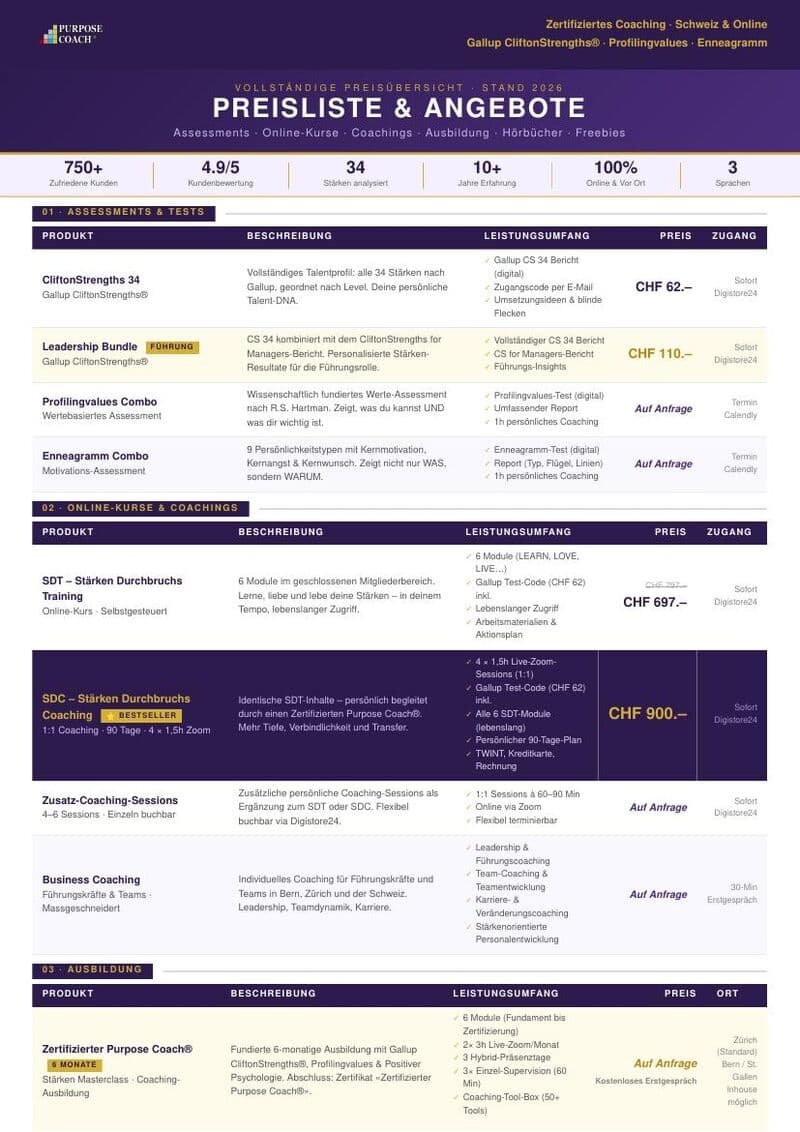
A CliftonStrengths® assessment with debrief starts at CHF 62, the SBT online course at CHF 697, and a full 1:1 SBC package ranges from CHF 1,490 to CHF 3,500 – depending on scope. In your free 30-min consultation you receive a transparent, tailored offer.
A CliftonStrengths® assessment with debrief starts at CHF 62, the SBT online course at CHF 697, and a full 1:1 SBC package ranges from CHF 1,490 to CHF 3,500 – depending on scope. In your free 30-min consultation you receive a transparent, tailored offer.
Look for accredited coaching training (e.g. ICF), scientifically validated tools (Gallup CliftonStrengths®, Profilingvalues) and verified client testimonials. PurposeCoach® is a certified Gallup Strengths Coach and Profilingvalues consultant with over 750 clients across Switzerland and Europe.
Look for accredited coaching training (e.g. ICF), scientifically validated tools (Gallup CliftonStrengths®, Profilingvalues) and verified client testimonials. PurposeCoach® is a certified Gallup Strengths Coach and Profilingvalues consultant with over 750 clients across Switzerland and Europe.
We open with a check-in on your current situation, go deep with focused questions, exercises and reflections around your strengths and values – and close with concrete next steps for the week ahead. After each session you receive a short summary with your key insights.
We open with a check-in on your current situation, go deep with focused questions, exercises and reflections around your strengths and values – and close with concrete next steps for the week ahead. After each session you receive a short summary with your key insights.
Yes. Over 70% of our sessions run online via Zoom – flexible from anywhere in Switzerland and Europe, often in the evening alongside your job. On-site coaching in Bern (Seftigenstrasse 302, Wabern) is ideal for intensive half-day sessions or team workshops. Impact studies show comparable results.
Yes. Over 70% of our sessions run online via Zoom – flexible from anywhere in Switzerland and Europe, often in the evening alongside your job. On-site coaching in Bern (Seftigenstrasse 302, Wabern) is ideal for intensive half-day sessions or team workshops. Impact studies show comparable results.
Book a free 30-minute initial consultation – non-binding and confidential. We clarify your goals, check the chemistry and you'll see whether our strengths-based approach fits you. If it doesn't, we're happy to refer you to other certified colleagues in our Swiss network.
Book a free 30-minute initial consultation – non-binding and confidential. We clarify your goals, check the chemistry and you'll see whether our strengths-based approach fits you. If it doesn't, we're happy to refer you to other certified colleagues in our Swiss network.
In session one we define measurable goals (e.g. career decision, energy level, team satisfaction) and use before/after self-assessments on a 1–10 scale. Your CliftonStrengths® profile remains your personal reference – we check after 90 days what has concretely changed in your daily life.
In session one we define measurable goals (e.g. career decision, energy level, team satisfaction) and use before/after self-assessments on a 1–10 scale. Your CliftonStrengths® profile remains your personal reference – we check after 90 days what has concretely changed in your daily life.
We use cookies and tracking tools (Google Analytics, Google Tag Manager and Meta/Facebook Pixel) to analyse website usage anonymously, improve our content and measure marketing performance. These tools only load after your consent — if you choose “Decline”, no tracking pixels are loaded and no data is sent to third parties. You can change your choice anytime in our Privacy Policy.